 Research Report by Taptwice Media
Research tools used:
 , Claude Cowork, ChatGPT, Gemini, Perplexity
Abstract
This study analyzes how four major AI engines — ChatGPT, Google Gemini, Google AI Mode, and Perplexity — represent US plumbing businesses in response to standardized recommendation queries across all 50 states. Using one identical prompt per state per engine (200 total queries), we extracted winning sentiment phrases, named business mentions, answer structure types, red-flag warnings, and citation URLs. The resulting dataset comprises 4,150 winning sentiment phrases, 1,609 agency name mentions, 622 red-flag phrases, and 2,060 citation URLs resolving to 645 unique domains. Licensing verification (411 mentions), customer review volume (370), and 24/7 emergency availability (355) are the three highest-frequency visibility signals across all engines. Each engine weights these signals differently: Google Gemini leads on licensing, Google AI Mode on review volume, ChatGPT on service breadth and longevity, and Perplexity on warranties and local presence. Citation analysis shows that seven of the twelve most-cited domains are curated consumer directories, not individual business websites. Two businesses — Benjamin Franklin Plumbing in Kansas and Champion Plumbing in Oklahoma — achieved named mentions across all four engines for their respective states. These findings establish the first published engine-by-engine baseline for AI visibility in the US plumbing industry and carry direct implications for answer engine optimization (AEO) and generative engine optimization (GEO) practice.
Keywords: answer engine optimization, generative engine optimization, AI visibility, local business, plumbing industry, citation analysis, ChatGPT, Google Gemini, Google AI Mode, Perplexity, large language models, local search
Introduction
For the last two years, the question we have been asked most often by plumbing business owners and by agencies selling plumbing SEO services has been a version of the same thing: when someone asks ChatGPT, Perplexity, Google Gemini, or Google AI Mode for the best plumbers in a specific state, how does the engine decide who to name, and what can a plumbing company do to get named?
We ran the study ourselves. In April 2026, we sent one identical prompt to each of the four major AI engines, in each of the 50 US states, then we extracted the answer verbatim, the brands the engine named, the factors the engine said it was using, the red flags it warned against, and every source URL it cited. The dataset is 200 engine-answers. The patterns inside it are clearer than we expected.
We are Taptwice Media, a GEO and AEO agency. The research below is written for two audiences. First, plumbing businesses who want to understand why AI engines already do or do not mention them, and what signals those engines are demonstrably paying attention to. Second, marketing agencies, plumbing SEO agencies, and independent freelancers who are running AEO projects for plumbing clients and need a current baseline for what visibility actually looks like inside the engines right now.
Literature Review
The displacement of traditional search engine results by AI-generated answers has been documented in industry usage data from 2023 onward, with consumer queries migrating from blue-link results toward conversational responses in ChatGPT, Google AI Mode, Perplexity, and similar systems. The optimization disciplines that have emerged in response — answer engine optimization (AEO) and generative engine optimization (GEO) — share a common empirical gap: most published frameworks describe general signal categories (citation authority, structured data, entity coverage) without establishing category-specific baselines.
Local service businesses present a distinct challenge in this landscape. Unlike e-commerce products or editorial topics, local service businesses compete within tight geographic constraints, are subject to state-level regulatory variation, and are evaluated by consumers on trust signals — licensing, insurance, reviews — that differ from the relevance signals traditional SEO optimizes. Prior published research on AI engine behavior in local service categories does not exist in indexed academic literature as of the date of this study. Industry publications have described AI engine behavior in general local search terms, but without the prompt-standardized, cross-engine, cross-state methodology needed to produce actionable baselines.
The plumbing category was selected because it combines high consumer urgency (emergency repairs), significant state-level regulatory variation (license classes, insurance minimums, permit requirements), and a large addressable market of businesses operating across all 50 states. These characteristics make it a productive test case for understanding how AI engines handle local service recommendations at national scale.
Methodology
The prompt sent to each engine was the same in every state, with only the state name swapped in:
“What are the factors to pick best plumbers in [State] and which are they according to those factors? Give me a list of top plumbers in [State].”
For each of the 200 engine-answers we then extracted five things:
- Winning sentiments, meaning the positive phrases and qualities the engine used to describe why a plumber is a good pick. These are the visibility signals the engine is rewarding.
- Top agencies, meaning the named plumbing businesses the engine put forward as recommended picks, in the order the engine gave them.
- Answer type, meaning the structural format of the answer (factors-plus-named-list, hedged framework, tabular regional list, and so on).
- Losing sentiments, meaning the red flags, warnings, and negative signals the engine called out as reasons to avoid a plumber.
- Other citations, meaning every source URL the engine attached to its answer.
Totals across the 200 engine-answers: 4,150 winning sentiment phrases, 1,609 agency name mentions, 622 red-flag phrases, and 2,060 cited URLs pointing to 645 unique domains. That is the corpus behind everything that follows.
Results
The ten universal visibility signals AI engines reward
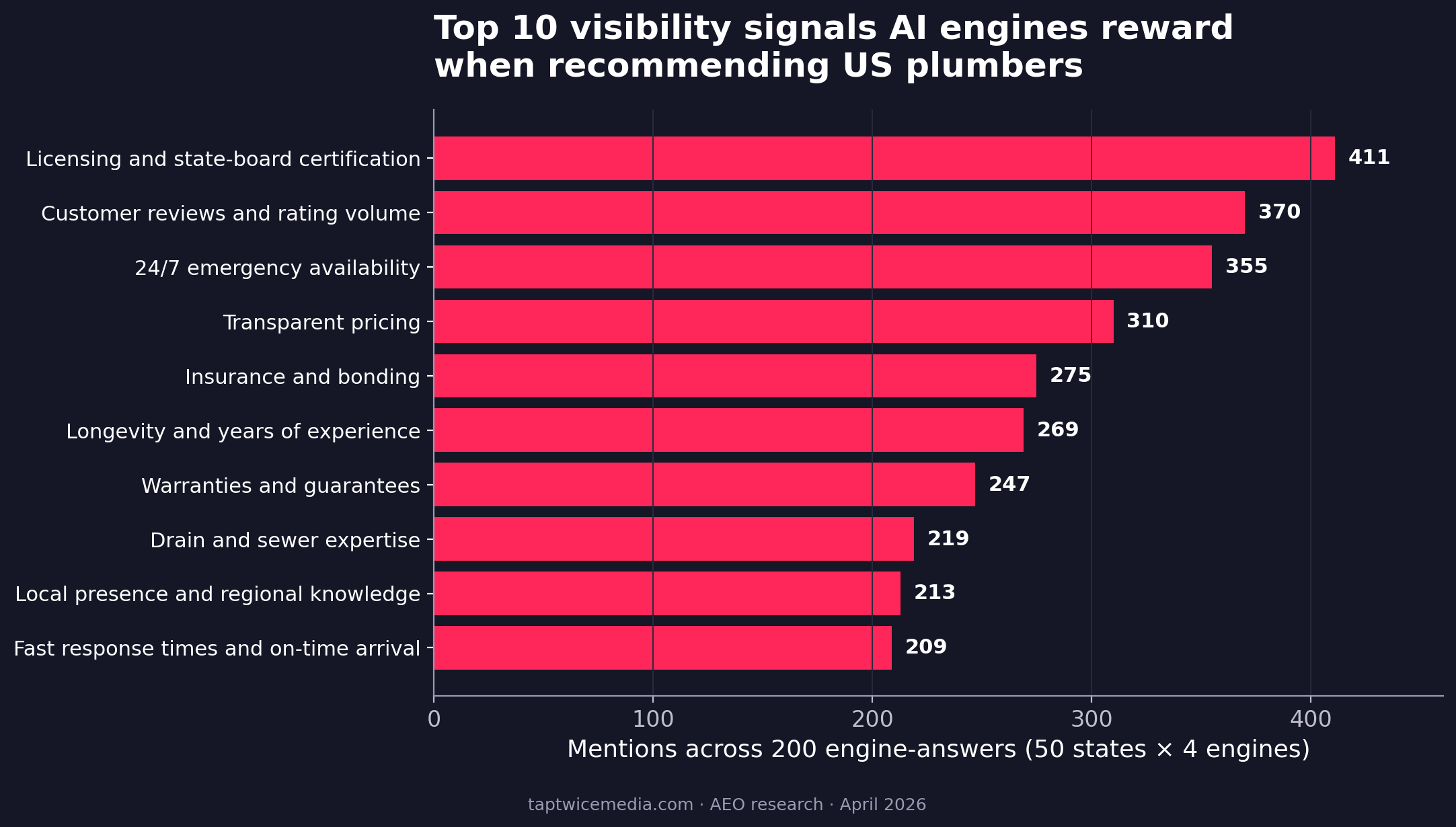
After normalizing phrases into canonical themes, ten signals dominate every engine, every state. If an engine is going to describe why a plumber is a good pick, it is overwhelmingly likely to reach for one of these ten.
| Rank | Signal | Mentions (of 200 engine-answers) |
|---|---|---|
| 1 | Licensing and state-board certification | 411 |
| 2 | Customer reviews and rating volume | 370 |
| 3 | 24/7 emergency availability | 355 |
| 4 | Transparent pricing (written estimates, flat-rate, no hidden fees) | 310 |
| 5 | Insurance and bonding | 275 |
| 6 | Longevity and years of experience | 269 |
| 7 | Warranties and guarantees on parts and labor | 247 |
| 8 | Drain and sewer expertise (hydro-jetting, trenchless, camera inspection) | 219 |
| 9 | Local presence and regional knowledge | 213 |
| 10 | Fast response times and on-time arrival | 209 |
Two observations. First, the top five are all verifiable facts about a business (license number, review volume, operating hours, price format, insurance policy). These are exactly the signals a well-structured website can put on a public page and expect an AI engine to pick up. Second, the next five mix verifiable facts with reputational claims (warranty length, years in business) and service specializations (drain, sewer, trenchless). These are the signals that get a plumber into the “named pick” tier rather than just the “generic example” tier.
Below the top ten, a second band of signals appears often enough to matter for specialized plumbers: cleanliness and floor-protection behavior (118 mentions), family-owned status (102), water heater expertise (93), full-service scope (91), HVAC integration (64), BBB accreditation (55), awards and local recognition (51), repiping (36), hard-water expertise (30), leak detection (30), older-home and historic-property work (29), and cold-climate expertise (24).
How each engine weighs the signals differently
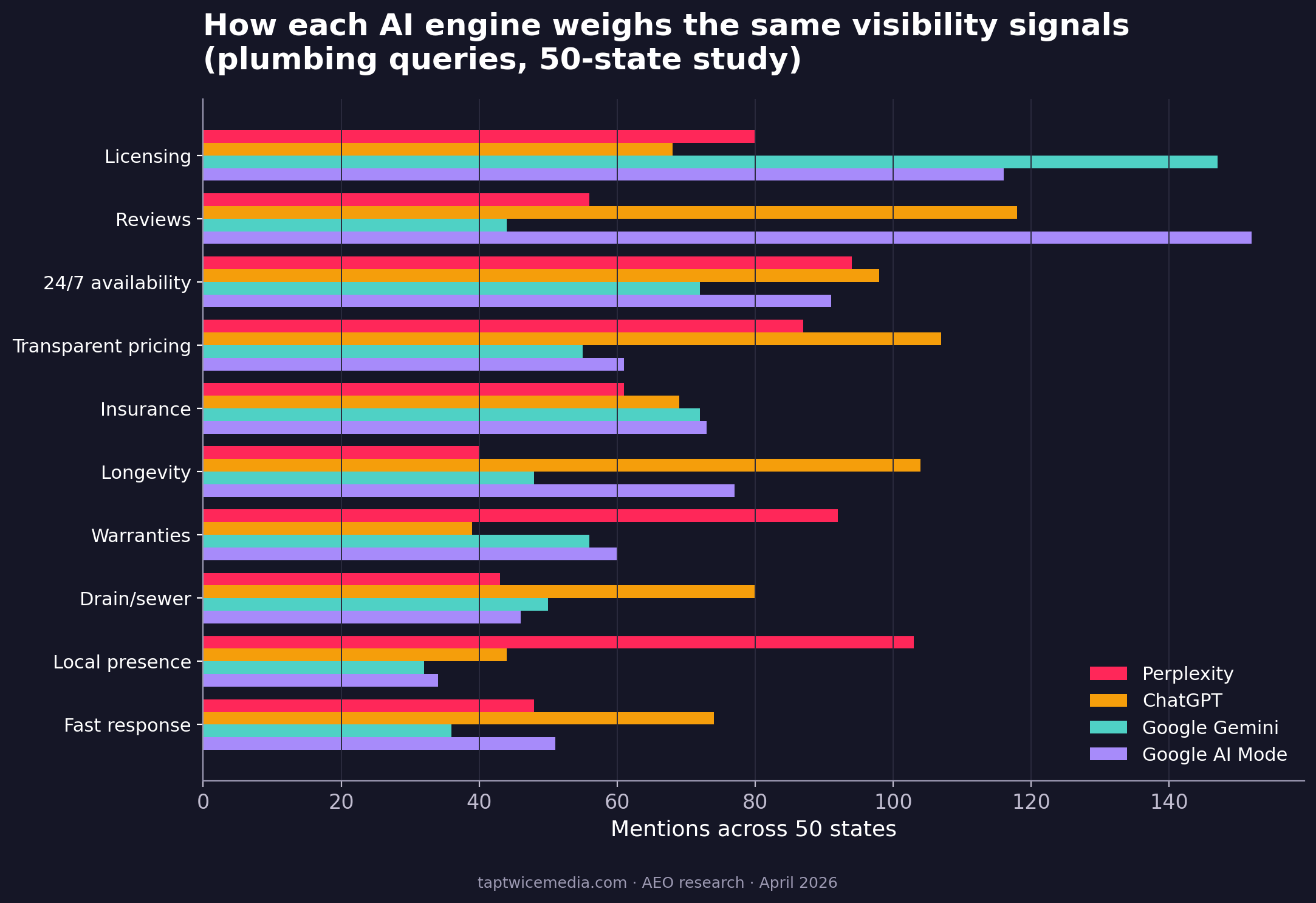
The four engines are not interchangeable. They agree on what the signals are, but they disagree on which signals matter most. If you are optimizing a plumbing business for AI visibility, the engine-specific weighting is where strategy starts.
| Signal | Perplexity | ChatGPT | Google Gemini | Google AI Mode |
|---|---|---|---|---|
| Licensing and certification | 80 | 68 | 147 | 116 |
| Customer reviews and rating volume | 56 | 118 | 44 | 152 |
| 24/7 emergency availability | 94 | 98 | 72 | 91 |
| Transparent pricing | 87 | 107 | 55 | 61 |
| Insurance and bonding | 61 | 69 | 72 | 73 |
| Longevity and experience | 40 | 104 | 48 | 77 |
| Warranties and guarantees | 92 | 39 | 56 | 60 |
| Drain and sewer expertise | 43 | 80 | 50 | 46 |
| Local presence and knowledge | 103 | 44 | 32 | 34 |
| Fast response times | 48 | 74 | 36 | 51 |
- Google Gemini is the licensing engine. It mentions state-board licensing almost twice as often as ChatGPT does, and it is the only engine that regularly cites the specific license tier (C-36 in California, P-1 in Connecticut, CMC-A in Tennessee, QB-XXXXX in Ohio) with verification URLs. If your goal is Gemini visibility, your license number and license class need to be on-page and verifiable.
- Google AI Mode is the reviews engine. It leads on customer review volume by a wide margin (152 mentions, versus 44 for Gemini). AI Mode almost always quotes a star rating and a review count in the same sentence as a business name (“4.9 with 2,000+ reviews”). If your goal is AI Mode visibility, review acquisition and schema markup for reviews is where the payoff sits.
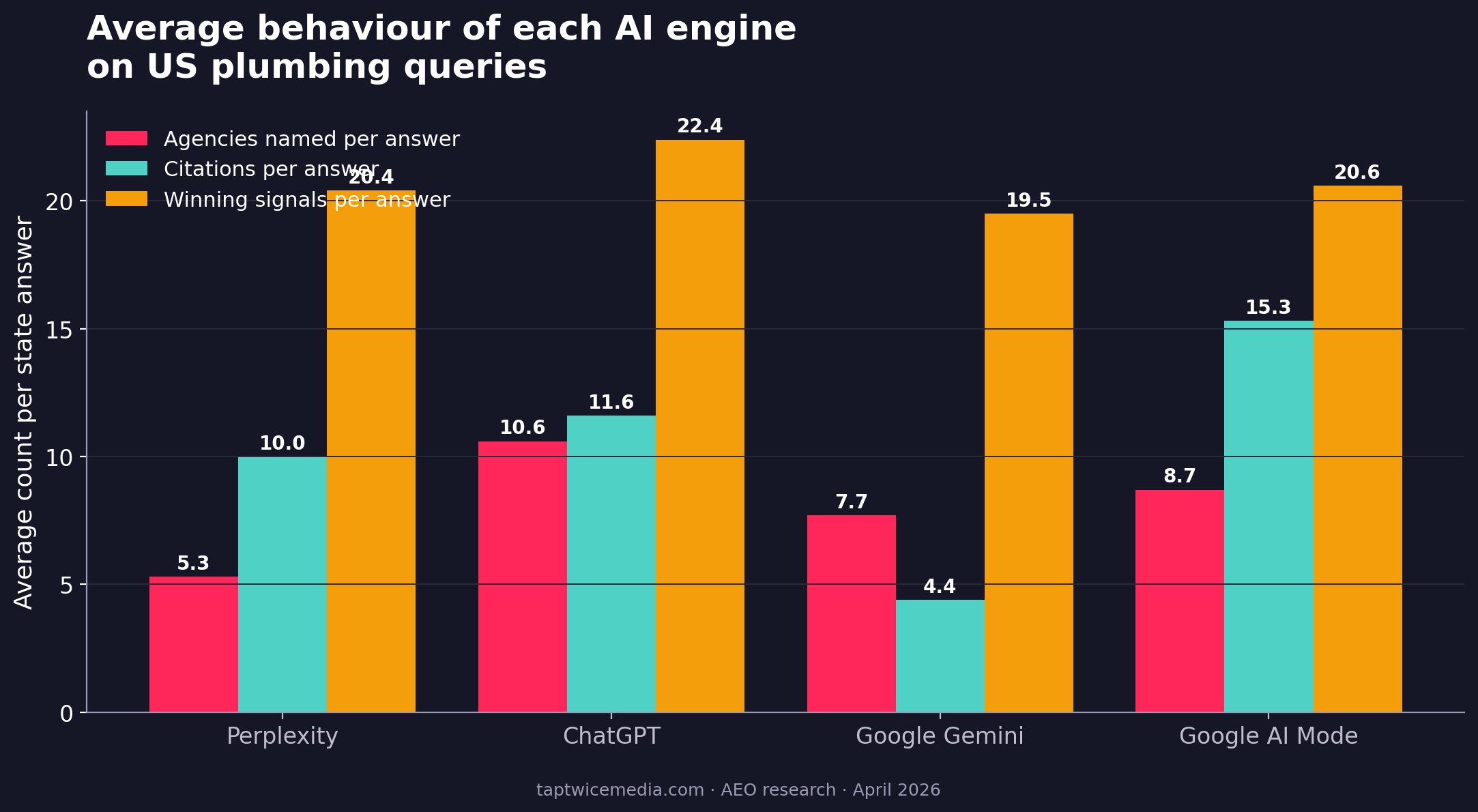
- ChatGPT is the longevity and service-breadth engine. It leads on years-in-business references, drain and sewer expertise, fast response times, and transparent pricing. It also names more businesses per answer than any other engine (average 10.6 per state), which makes it the most forgiving engine to enter as a mid-tier regional plumber.
- Perplexity is the warranty and local-presence engine. Its dominant signals are workmanship warranties and local-area familiarity. Perplexity is also the only engine that hedges (refused to name any specific business in Alabama, Alaska, Mississippi, and Missouri), which means its bar for naming a brand is higher than the other three.
Regional and climate-driven signals
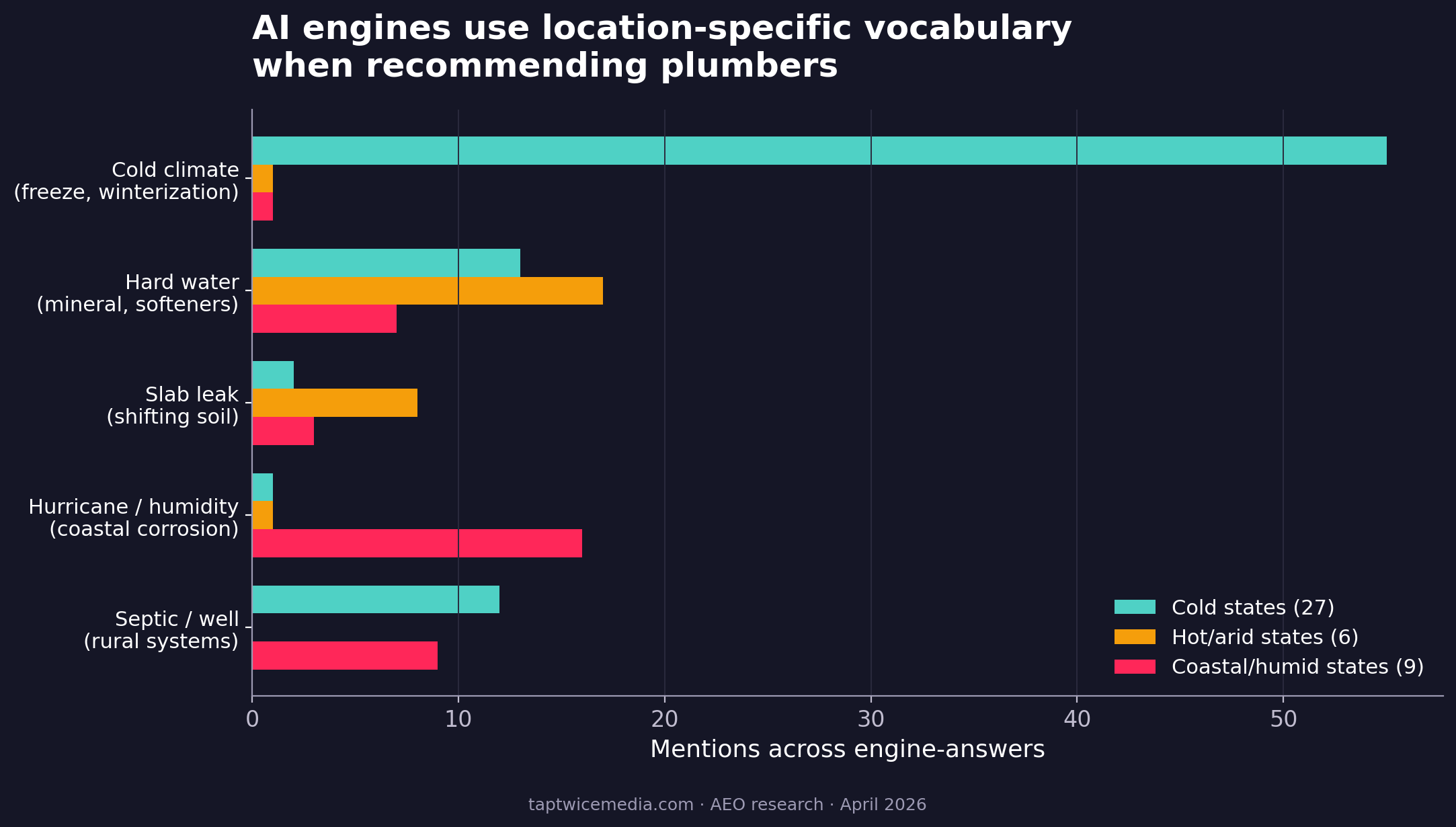
Some signals are universal. Others are location-bound, and the engines are unambiguous about which is which. The table below counts mentions of each signal inside three regional groupings of states.
| Signal | Cold states (27) | Hot and arid states (6) | Coastal and humid states (9) |
|---|---|---|---|
| Cold-climate, freeze, winterization, heat tape | 55 | 1 | 1 |
| Hard water, mineral buildup, water softener | 13 | 17 | 7 |
| Slab leak, shifting soil, foundation | 2 | 8 | 3 |
| Hurricane, humidity, coastal corrosion, mold | 1 | 1 | 16 |
| Septic system, well pump, well water | 12 | 0 | 9 |
The implication for a plumbing business is that the content you publish should match the environmental vocabulary the engines are already using for your state. A plumber in Alaska writing about “burst pipes” is competing with a national template. A plumber in Alaska writing about “heat tape installation, pipe insulation at depth, and 20-minute dispatch in a Fairbanks cold snap” is using the exact phrasing Gemini and AI Mode put into their answers for Alaska.
A few location-specific vocabularies were particularly consistent across engines:
- Alaska, Idaho, Maine, Minnesota, Montana, North Dakota, South Dakota, Vermont, Wisconsin, Wyoming. Winterization, heat tape, frozen pipe thawing, boiler and glycol systems, 24-hour dispatch during cold snaps. Alaska in particular pulled “arctic-ready expertise” and “thermal management” from Gemini.
- Arizona, California, Nevada, New Mexico, Texas, Utah. Hard-water scaling, water softeners, descalers, slab leak detection, trenchless sewer repair under shifting clay soil, hydro-jetting, and evaporative cooler plumbing (New Mexico specifically).
- Florida, Louisiana, Mississippi, Hawaii. Humidity-driven mold risk, coastal salt corrosion, hurricane burst-pipe readiness, septic systems on rural properties, solar water heater expertise (Hawaii). Florida has the clearest regulatory vocabulary of any state, with Gemini and AI Mode both quoting DBPR’s Certified-versus-Registered distinction and the $100,000 public liability and $25,000 property damage insurance minimums.
- Illinois, Massachusetts, New York, New Jersey, Pennsylvania, Connecticut, Maryland, Rhode Island. Older housing stock, galvanized and cast-iron pipes, pre-war apartments, co-op and condo Certificate of Insurance requirements, city-level license overlays (Chicago 055/058 prefixes, NYC Master Plumber DOB, CT P-1/P-2, MA eLIPSE portal).
Consensus picks: plumbing businesses named by multiple engines in the same state
The highest-quality visibility signal we found is when more than one engine independently names the same business in the same state. This is a demonstration that the business has broken through into the engines’ training or retrieval layer from multiple source pipelines. Twenty-three businesses achieved this across the 50 states.
| State | Business | Engines that named it |
|---|---|---|
| Arizona | Parker & Sons | Perplexity, ChatGPT, Gemini |
| Arkansas | Paschal Air, Plumbing & Electric | ChatGPT, Gemini, AI Mode |
| Arkansas | Ray Lusk Plumbing | Perplexity, ChatGPT, AI Mode |
| Delaware | Delaware Plumbing Professionals | ChatGPT, Gemini, AI Mode |
| Idaho | Plumbing Solutions of Idaho | Perplexity, Gemini, AI Mode |
| Kansas | Benjamin Franklin Plumbing | All four |
| Louisiana | American Plumbing | ChatGPT, Gemini, AI Mode |
| Maine | Mainely Plumbing & Heating | Perplexity, ChatGPT, Gemini |
| Nevada | Pure Plumbing & Air | ChatGPT, Gemini, AI Mode |
| New Jersey | Service Professionals | ChatGPT, Gemini, AI Mode |
| New Jersey | Gold Medal Service | Perplexity, Gemini, AI Mode |
| North Dakota | Laney’s Inc. | ChatGPT, Gemini, AI Mode |
| North Dakota | Rivers Edge Plumbing & Heating | ChatGPT, Gemini, AI Mode |
| Oklahoma | Champion Plumbing | All four |
| Oklahoma | Hull Plumbing, Inc. | Perplexity, Gemini, AI Mode |
| Oregon | 3 Mountains Home Services | Perplexity, Gemini, AI Mode |
| Oregon | Meticulous Plumbing | ChatGPT, Gemini, AI Mode |
| Pennsylvania | Horizon Services | Perplexity, ChatGPT, Gemini |
| South Dakota | Roger’s Plumbing & Heating | ChatGPT, Gemini, AI Mode |
| Tennessee | Hiller Plumbing, Heating, Cooling & Electrical | Perplexity, ChatGPT, AI Mode |
| Utah | Beehive Plumbing | ChatGPT, Gemini, AI Mode |
| Wisconsin | Benjamin Plumbing | ChatGPT, Gemini, AI Mode |
| Wyoming | Aspen Mountain Plumbing | ChatGPT, Gemini, AI Mode |
Two businesses, Benjamin Franklin Plumbing in Kansas and Champion Plumbing in Oklahoma, were named by all four engines for the same state. These are the cleanest examples we have of full-spectrum AI visibility in the plumbing industry as of April 2026. A franchise network helps on the Benjamin Franklin side. On the Champion side, it is a single local business that has cleared the bar on every engine.
A few national brands show up repeatedly across states rather than dominating a single state. Benjamin Franklin Plumbing was named in 15 states. Roto-Rooter variants (Roto-Rooter Plumbing & Water Cleanup and Roto-Rooter) together appeared in 27 states. Mr. Rooter Plumbing appeared in 11 states. These are the three brands with the deepest cross-state AI presence. If you are competing against them at the local level, the more productive strategy is city-specific and neighborhood-specific content rather than attempting to outrank the national brand on a generic “plumber” query.
What each engine reaches for when it names a business
Each engine has a small roster of brands it reaches for disproportionately often. The roster reveals how that engine sources its recommendations.
ChatGPT
- Roto-Rooter Plumbing & Water Cleanup, named in 12 states
- Benjamin Franklin Plumbing, 10 states
- Mr. Rooter Plumbing, 6 states
- Five Star Plumbing, Horizon Services, Delaware Plumbing Professionals, Summers Plumbing Heating & Cooling, Workman & Son’s Plumbing, Len The Plumber, Roto-Rooter, each named in 2 states
ChatGPT is comfortable naming national franchises and regional chains. It has the highest average number of businesses per answer (10.6) and the lowest refusal rate (0). It also repeatedly cites directories like Expertise.com (75 citations), TrustAnalytica (41), and Forbes (22), which explains why the same franchises keep surfacing.
Google AI Mode
- Heritage Home Service, 3 states
- Roto-Rooter Plumbing & Water Cleanup, 3 states
- Shaw Plumbing, Anthony Plumbing Heating Cooling & Electric, Roto-Rooter, Benjamin Franklin Plumbing, John’s Sewer & Drain Cleaning, each in 2 states
AI Mode has the most diffuse roster. It names different businesses in nearly every state because it leans heavily on Google local-business data (Yelp at 85 citations, ServiceTitan at 50, Angi at 27). It also carries review counts and star ratings into its prose more faithfully than any other engine.
Google Gemini
- Roto-Rooter, 9 states
- Benjamin Franklin Plumbing, 6 states
- Horizon Services, 3 states
- Mr. Rooter Plumbing, Sunshine Plumbing, Anthony Plumbing Heating & Cooling, Lee Company, Hoffmann Brothers, Carroll Plumbing & Heating, Precision Plumbing, each in 2 states
Gemini leans heavily on licensing databases and state regulator websites. Its top citation sources are ServiceTitan (25 citations), NEXT Insurance (12), Angi (12), and Housecall Pro (10), all of which are industry-operator resources rather than consumer directories. That is the reason its answers are so licensing-heavy.
Perplexity
- Sunshine Plumbers, 4 states
- Benjamin Franklin Plumbing, 3 states
- Mr. Rooter Plumbing, 3 states
Perplexity has the shortest named-brand tail of any engine. It prefers to describe types of businesses (“established Birmingham-area companies with long local histories”, “regional franchises with nationwide branding”) rather than commit to specific brand names in states where it is less confident. Its top citations are Angi (45), FixAndFlow (22), Expertise (20), and HomeSpotHQ (19), which is a mix of consumer directories and plumbing-industry blogs.
Where AI engines source their plumbing information
Across all four engines, the 2,060 citations resolve to 645 unique domains. The top twelve account for roughly 46% of every citation we saw. This is the most consolidated part of the dataset, and it tells a working SEO team exactly which sites to prioritize.
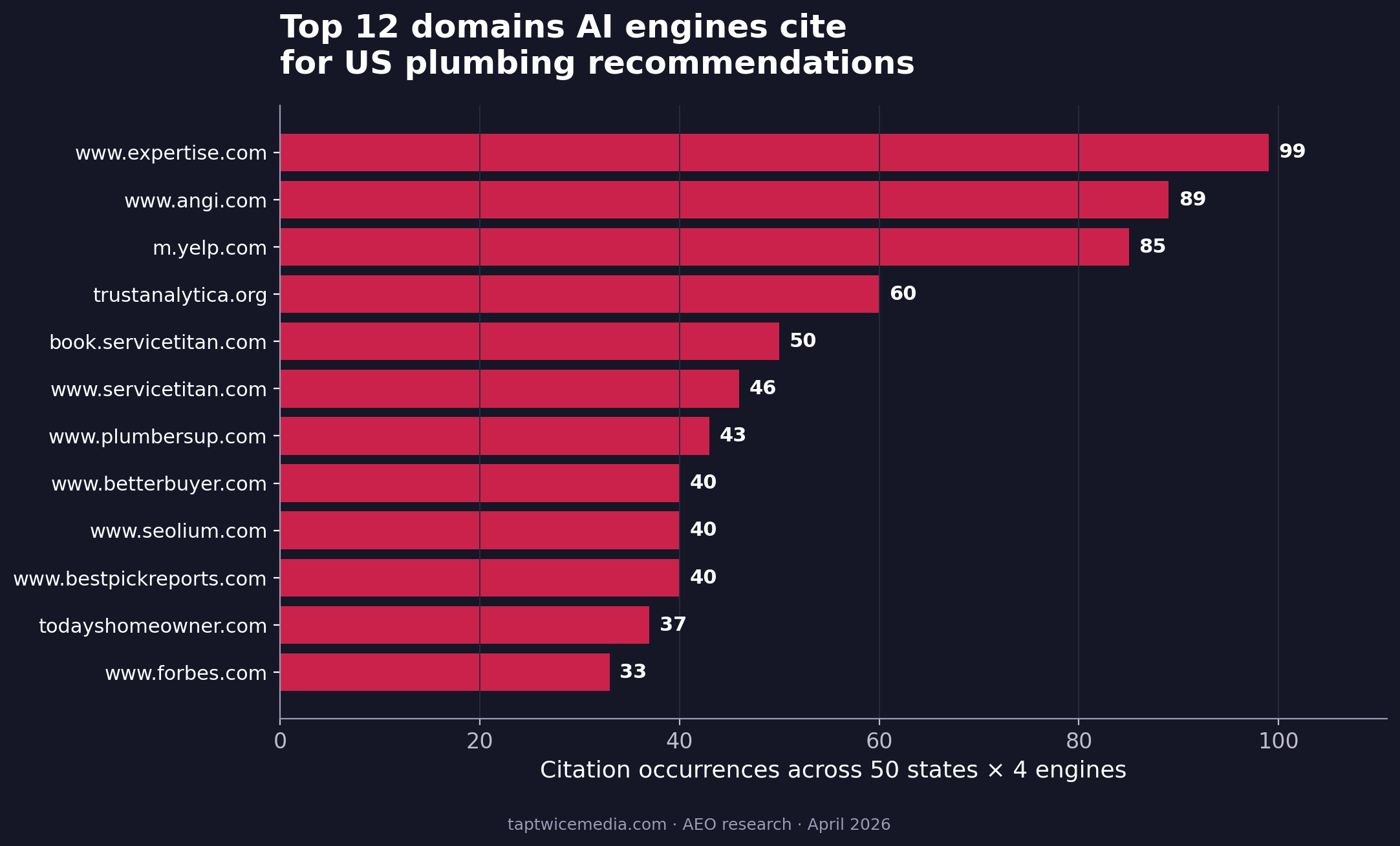
| Rank | Domain | Unique URLs cited | Total citation occurrences |
|---|---|---|---|
| 1 | www.expertise.com | 81 | 99 |
| 2 | www.angi.com | 76 | 89 |
| 3 | m.yelp.com | 85 | 85 |
| 4 | trustanalytica.org | 54 | 60 |
| 5 | book.servicetitan.com | 50 | 50 |
| 6 | www.servicetitan.com | 33 | 46 |
| 7 | www.plumbersup.com | 37 | 43 |
| 8 | www.betterbuyer.com | 37 | 40 |
| 9 | www.seolium.com | 31 | 40 |
| 10 | www.bestpickreports.com | 28 | 40 |
| 11 | todayshomeowner.com | 33 | 37 |
| 12 | www.forbes.com | 25 | 33 |
Seven of the top twelve are curated directories: Expertise.com, Angi, Yelp, TrustAnalytica, Best Pick Reports, BetterBuyer, and Today’s Homeowner. Two are plumbing operator platforms (ServiceTitan booking and parent). Two are plumbing ranking aggregators (PlumbersUp, Seolium). One is a news and editorial publisher (Forbes). Reddit, Oatey, Power Pro Plumbing, and BBB all appear with 20+ citations each just below the top twelve.
What is not in the top twelve is as useful to notice as what is. No city newspaper, no local TV station, no single plumbing company’s own website, and no Google Business Profile page ranked inside the top twelve. AI engines are mostly not citing individual plumbing businesses directly. They are citing the directories and ranking sites that have already curated those businesses.
Each engine has a distinct citation profile
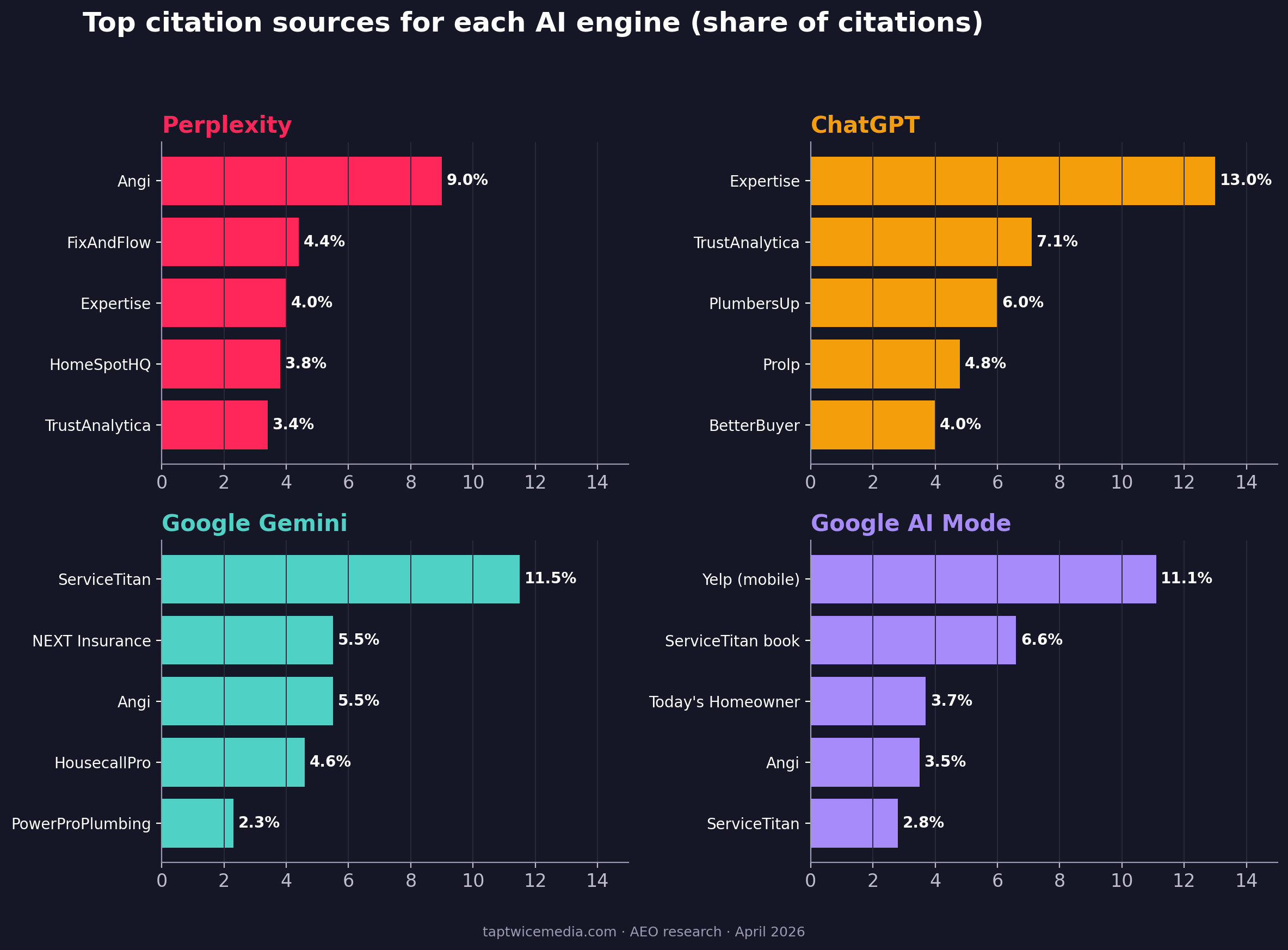
If you are optimizing for a specific engine, the sourcing patterns below matter more than the raw aggregated list.
- ChatGPT pulls heavily from Expertise.com (13% of its citations), TrustAnalytica (7.1%), PlumbersUp (6%), Prolp (4.8%), BetterBuyer (4%), and Forbes (3.8%). If your plumbing client is not listed on Expertise.com, that is the single highest-leverage missing citation for ChatGPT visibility in our dataset.
- Google AI Mode pulls most heavily from Yelp mobile (11.1%), ServiceTitan booking (6.6%), Today’s Homeowner (3.7%), Angi (3.5%), ServiceTitan.com (2.8%), Oatey (2.2%), and Yahoo Local (2.1%). AI Mode visibility is a Google-ecosystem problem first and a review-volume problem second.
- Perplexity pulls from Angi (9%), FixAndFlow (4.4%), Expertise (4%), HomeSpotHQ (3.8%), TrustAnalytica (3.4%), Seolium (3.2%), and This Old House (3%). Its sourcing is less consolidated than the other engines and tips toward industry blogs.
- Google Gemini pulls from ServiceTitan (11.5%), NEXT Insurance (5.5%), Angi (5.5%), Housecall Pro (4.6%), Power Pro Plumbing (2.3%), Roto-Rooter (2.3%), Plumbers Training Institute (2.3%), and Today’s Homeowner (2.3%). Gemini’s sourcing is dominated by operator-facing resources that explain licensing and regulation, which is why it quotes license classes and insurance minimums more than any other engine.
Gemini also has the lowest total citation volume of any engine (218 citations versus 763 for AI Mode), which is worth noting if a client is specifically asking about Gemini reach. Gemini’s answers are the densest in regulatory language, but the thinnest in cited support.
The red flags AI engines call out
Engines spent 622 phrases warning users about what to avoid. The warnings cluster into a short list of themes, and the distribution across engines is asymmetric in a way that matters for strategy.
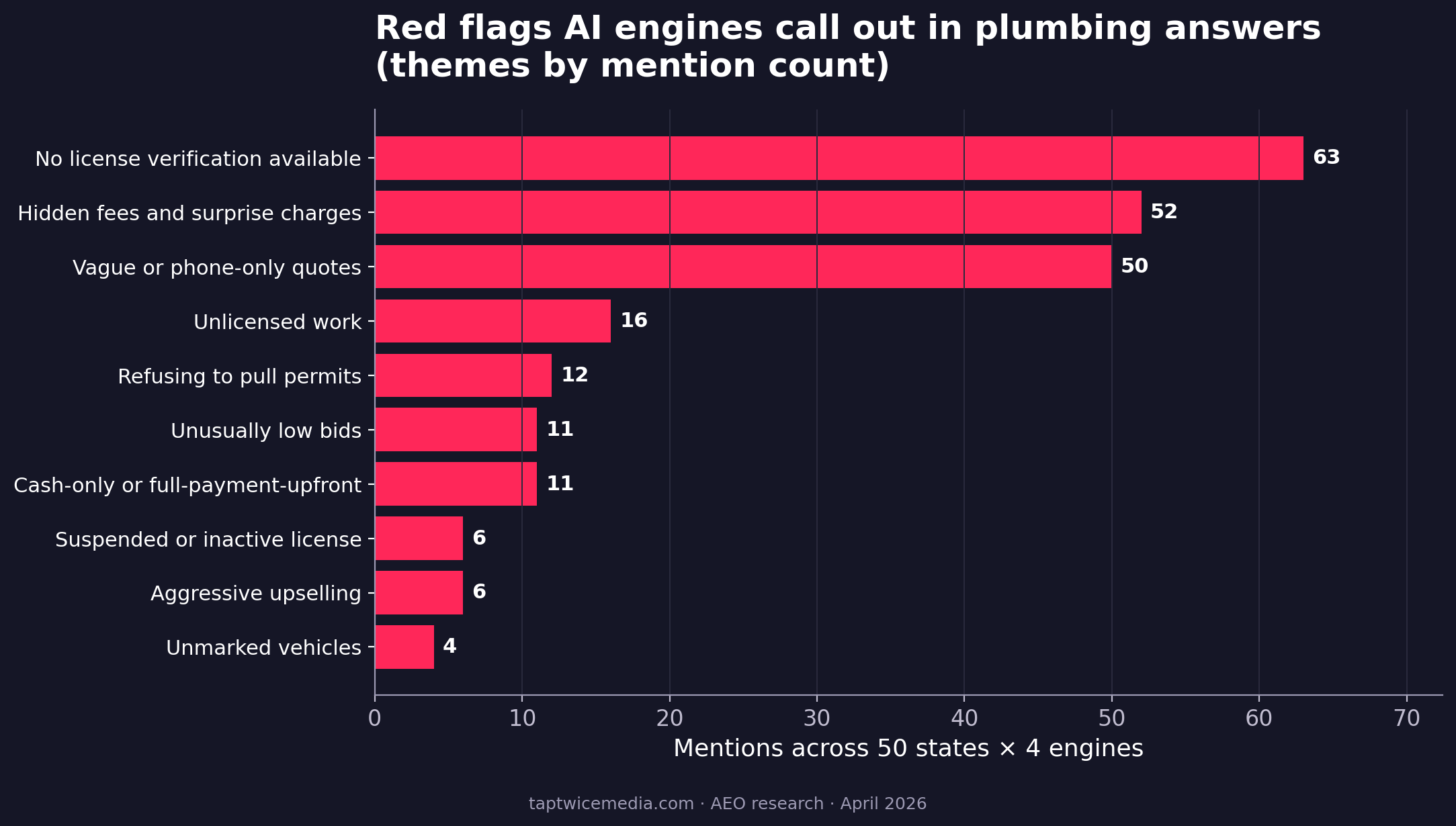
| Red flag theme | Total mentions | Perplexity | ChatGPT | Gemini | AI Mode |
|---|---|---|---|---|---|
| No license verification available | 63 | 43 | 2 | 7 | 11 |
| Hidden fees and surprise charges | 52 | 1 | 36 | 6 | 9 |
| Vague or phone-only quotes without an inspection | 50 | 4 | 5 | 19 | 22 |
| Unlicensed work | 16 | 0 | 2 | 9 | 5 |
| Refusing to pull permits | 12 | 2 | 0 | 8 | 2 |
| Unusually low bids suggesting cut corners | 11 | 3 | 1 | 4 | 3 |
| Cash-only or full-payment-upfront demands | 11 | 1 | 0 | 8 | 2 |
| Suspended or inactive license status | 6 | 0 | 0 | 5 | 1 |
Perplexity carries most of the “unverifiable license” warning load because Perplexity is the most honest of the four engines about the limits of its own retrieval, and it says so openly in the answers we collected. ChatGPT carries most of the “hidden fees” warnings because it leans hardest on pricing transparency as a positive signal and inverts that same language into the warning. Gemini and AI Mode carry most of the vague-phone-quote and cash-only warnings because both engines quote regulatory and consumer-protection guidance from state websites.
Answer format patterns by engine
How an engine structures an answer matters because structure is what a business page can emulate. The four engines have distinct default structures.
- ChatGPT tends toward numbered top-10 lists preceded by a factors section, often with use-case groupings at the end (“best for emergency”, “best for remodels”). If your site has a “choose your plumber” page, this structure is the one that most reliably feeds ChatGPT retrieval.
- Google Gemini tends toward tabular regional lists segmented by metro area, with license class and insurance minimums called out in a separate “key factors” section. The table format is consistent enough that a JSON-LD local-business schema with explicit regional-service-area fields is the closest content equivalent.
- Google AI Mode tends toward rating-rich tabular lists with explicit star ratings and review counts embedded next to each business name. A client’s Google Business Profile, Yelp profile, and Angi profile all feed this format directly.
- Perplexity tends toward hedged framework-first answers where the factors dominate and named brands appear only when retrieval confidence is high. A well-structured factors-and-local-examples page, with verifiable claims on each example, is the pattern most likely to clear Perplexity’s bar.
Discussion
The data above is the first public research we have seen on how plumbing businesses specifically are represented across the four major AI engines. Three practical conclusions follow for an individual plumbing company.
- Your license number and insurance minimums belong on your homepage, your about page, and every service page. Licensing was mentioned 411 times across the dataset and it is the number one signal for Gemini. Put the license class (C-36, P-1, M-, QB-, 36BI, or whatever your state uses), the issuing authority name, and a verification URL somewhere the retrieval layer can see them. This is the single highest-ROI content change you can make for AI visibility in the plumbing category.
- Your directory presence on Expertise.com, Angi, Yelp, TrustAnalytica, and Best Pick Reports is disproportionately valuable. Seven of the top twelve cited domains are curated directories. AI engines are mostly not citing individual plumbing businesses’ own websites, they are citing the directories that curate those businesses. A claim on each of the top seven, with complete service descriptions and a license number on the profile, is worth more than most on-site SEO work.
- Climate and regional vocabulary should be explicit. If you are in Alaska, your content should name “heat tape”, “pipe thawing”, “boiler and glycol systems”, and cite specific dispatch times during cold snaps. If you are in Arizona, your content should name “slab leak detection”, “hard water scaling”, and “C-36 license”. The engines are already using this vocabulary in their answers. Pages that use the same vocabulary are retrievable. Pages that do not use it are not.
One additional note for plumbing businesses that have been penalized by Perplexity specifically: Perplexity refused to name any plumbing business at all in four states (Alabama, Alaska, Mississippi, Missouri). If you operate in one of those four, you are not losing to a competitor inside Perplexity. You are losing because Perplexity has chosen not to make a recommendation at all. The fix is to give Perplexity a citeable source to retrieve from, which means a clean directory listing on one of its top-cited sources (Angi, FixAndFlow, Expertise, HomeSpotHQ, TrustAnalytica, Seolium, This Old House).
For agencies and independent freelancers running AEO projects for plumbing clients, the dataset supplies a current baseline for what visibility actually looks like across the four major engines. Three workflow-level observations follow.
- Engine-specific benchmarks beat aggregated benchmarks. The four engines have different citation sources, different signal weightings, and different brand rosters. A plumbing client asking for “AI visibility” is really asking about four separate visibilities. Segmenting your reporting by engine turns an intangible metric into four concrete ones: Gemini visibility (licensing and regulation focus), AI Mode visibility (review volume and local-data focus), ChatGPT visibility (directory and longevity focus), and Perplexity visibility (warranty and local-presence focus).
- Consensus mentions are the cleanest KPI. A plumbing business named by one engine might be a coincidence of retrieval. A plumbing business named by three or more engines in the same state (the Kansas Benjamin Franklin pattern, the Oklahoma Champion Plumbing pattern) has broken through into the retrieval layer from multiple source pipelines. Measuring and reporting on “engines-mentioning-client” as a count out of four gives clients a metric that maps cleanly to intuitive progress.
- Directory optimization is underweighted in most plumbing SEO workflows. The current industry default is to treat on-site content as the primary deliverable and directory listings as secondary. Our data suggests the ratio should be inverted for AEO specifically. Seven of the top twelve cited domains are directories. A client whose Expertise.com, Angi, Yelp, and Best Pick Reports profiles are thin or missing is invisible to a material share of the citation graph no matter how good their own site is.
A practical addition for competitive positioning: the consensus-picks table above is a ready-made list of which national franchise you are competing against in which state, and which single-state independents have already won the AI-visibility bar. A defensive audit against the named businesses in each client’s state, looking for what they have on their site, directory profiles, and license documentation, produces a concrete gap list.
Conclusion
The 200-engine-answer dataset analyzed in this study establishes three findings with direct practical consequence. First, AI engine visibility in the plumbing category is dominated by a short list of verifiable business signals — licensing, review volume, emergency availability, pricing transparency, and insurance — that any plumbing business can address through on-page content and directory profile completion. Second, the citation graph is controlled by a small number of curated directories, not individual business websites; optimization effort directed at directory profiles returns more AI visibility per unit of work than equivalent effort on owned-site content. Third, the four major AI engines are not interchangeable surfaces: they weight signals differently, source from different citation rosters, and structure their answers in distinct formats.
A plumbing business or AEO agency that treats AI visibility as a single undifferentiated target will systematically underperform one that tracks and optimizes each engine independently. The consensus-mention count — the number of engines that independently name a given business for its state — is the single most useful KPI this dataset suggests for tracking progress toward full-spectrum AI visibility. Two businesses in the entire United States have cleared that bar across all four engines simultaneously. The path they have taken is legible in the signal data above.
Limitations
This research captures a single April 2026 snapshot. Each engine’s retrieval and ranking layer updates frequently, and individual queries vary with session context, user location, and engine-side A/B testing. The patterns above are strong because they replicate across 50 independent state-level queries on each engine, but any specific brand mention in any specific state is a probabilistic outcome, not a guarantee.
The dataset also does not separate what an engine says it is using from what its retrieval layer actually weights. When Gemini cites a license class, we can confirm that the license-class signal was present in the answer text. We cannot confirm that the license was the signal that caused the business to be retrieved in the first place. Those are separate questions that require different instrumentation to answer.
What the dataset does establish is the surface area. When an AI engine produces a plumbing-business recommendation for a US state, these are the signals, sources, and brand-name patterns it is using. That surface is the one a plumbing business, a marketing agency, or a freelance AEO specialist needs to optimize against.
Future Research
Three lines of inquiry follow naturally from this dataset.
Longitudinal replication. This study captures a single snapshot. Repeating the same 200-query protocol at six-month intervals would allow tracking of whether the signal weights, citation rosters, and named-brand patterns are stable or shifting. Stability would confirm that the optimization targets identified here are durable. Drift would identify which engine is changing fastest and in which direction.
Cross-category extension. The plumbing category was chosen because it combines regulatory complexity, geographic variation, and consumer urgency in a tractable scope. The same protocol applied to HVAC, electrical contracting, roofing, and other residential service trades would allow cross-category comparison of AI engine behavior in local service contexts, and would identify whether the directory-citation dominance finding replicates across trades or is plumbing-specific.
Retrieval-versus-stated-signal separation. This study documents what AI engines say they are using when they recommend a plumber. It does not document what signals caused a given business to be retrieved in the first place. A pre/post design — controlled on-page content changes paired with repeated engine queries over time — would begin to separate stated signals from actual retrieval weights, which is the more actionable variable for optimization practice.
References
The following domains were cited by one or more engines across the 200 engine-answers collected for this study. Full citation counts per domain and per engine are reported in the Results section above.
- Angi — www.angi.com
- Best Pick Reports — www.bestpickreports.com
- BetterBuyer — www.betterbuyer.com
- Expertise.com — www.expertise.com
- FixAndFlow — fixandflow.com
- Forbes — www.forbes.com
- HomeSpotHQ — homespothq.com
- Housecall Pro — www.housecallpro.com
- NEXT Insurance — www.nextinsurance.com
- Oatey — www.oatey.com
- PlumbersUp — www.plumbersup.com
- Plumbers Training Institute — www.plumberstraininginstitute.com
- Power Pro Plumbing — www.powerproplumbing.com
- Prolp — prolp.com
- Reddit — www.reddit.com
- Roto-Rooter — www.rotorooter.com
- Seolium — www.seolium.com
- ServiceTitan (booking) — book.servicetitan.com
- ServiceTitan — www.servicetitan.com
- This Old House — www.thisoldhouse.com
- Today’s Homeowner — todayshomeowner.com
- TrustAnalytica — trustanalytica.org
- Yahoo Local — local.yahoo.com
- Yelp (mobile) — m.yelp.com
Appendix
The raw dataset underlying this report — 200 engine-answers, one per engine per US state — is available to verified researchers, AEO practitioners, and plumbing industry associations on request. Each record contains the full answer text, the list of named businesses in order, the winning sentiment phrases extracted, the red-flag phrases extracted, and all citation URLs as captured in April 2026. Contact Taptwice Media at shubham@taptwicemedia.com to request access.
About the research
This study was run by Taptwice Media, a GEO and AEO agency specializing in brand visibility across AI engines. The 200 engine-answers underlying the findings were collected in April 2026 from ChatGPT, Perplexity, Google Gemini, and Google AI Mode, using one identical prompt per state. Extraction of winning sentiments, named agencies, red flags, citations, and answer-type labels was done manually, cell by cell, with each cell cross-checked against the raw answer text.
If you run a plumbing business or work on plumbing SEO, and you want to map this research to your client or your own brand’s current footprint across the four engines, Taptwice Media offers brand mention tracking across AI engines and sentiment control as ongoing services. The methodology in this report is the same one we use for client-specific audits.
Does your plumbing business appear in AI answers?
When you want to hire an AEO agency for your plumbing business, you want an agency that is data-backed, believes in research and knows what it is doing. And guess which company just posted a deep report on plumbing business visibility in AI?
Taptwice Media. We audit your AI visibility, identify exactly where you are missing from AI answers, and build a plan to get your plumbing business cited consistently across ChatGPT, Perplexity, Gemini, and Google AI Mode.