The short answer is yes. Several platforms now monitor how AI engines like ChatGPT, Perplexity, Gemini, Grok, and Claude mention brands in their responses. Some let you check on demand, others run on a schedule and deliver updated visibility data automatically.
Here are the platforms that do this, and a full walkthrough of the one we use and recommend.
Platforms That Track Brand Citations in AI Engines
1. Rankscale
Founded by Mathias Ptacek, Rankscale is built specifically for AI search visibility tracking. It covers all major AI engines, supports bulk keyword uploads, and lets you schedule automated runs so you are not checking manually every time. The reporting covers brand visibility, competitor share of voice, sentiment, and citation sources.
2. Otterly
Founded by Thomas Peham, Josef Trauner, and Klaus-M. Schremser, Otterly is one of the earliest dedicated AI search monitoring tools. It launched in October 2024 and has grown to over 20,000 users. It tracks how your brand appears in AI-generated responses and surfaces competitor mentions in the same answers.
3. Ubersuggest
Built and acquired by Neil Patel, Ubersuggest has added AI visibility tracking to its established SEO feature set. It is a practical option for teams already using Ubersuggest for keyword research who want to layer in AI monitoring without switching platforms.
4. Morningscore
Founded by Karsten Madsen in Denmark, Morningscore is a gamified SEO and GEO platform that reached $1M ARR in 2025. It tracks AI answer visibility alongside traditional SEO metrics, making it useful for smaller teams that want a unified dashboard.
5. Semrush
Co-founded by Oleg Shchegolev and Dmitri Melnikov in 2008, Semrush has integrated AI Overview and AI mention tracking into its existing suite. The advantage is data breadth alongside traditional search metrics. AI tracking is one feature among many, not the core focus.
How to Track Brand Citations Automatically Using Rankscale
Rankscale is the strongest option if you need bulk tracking across multiple AI engines on a schedule. Here is the exact workflow.
Step 1: Create Your Brand in Rankscale
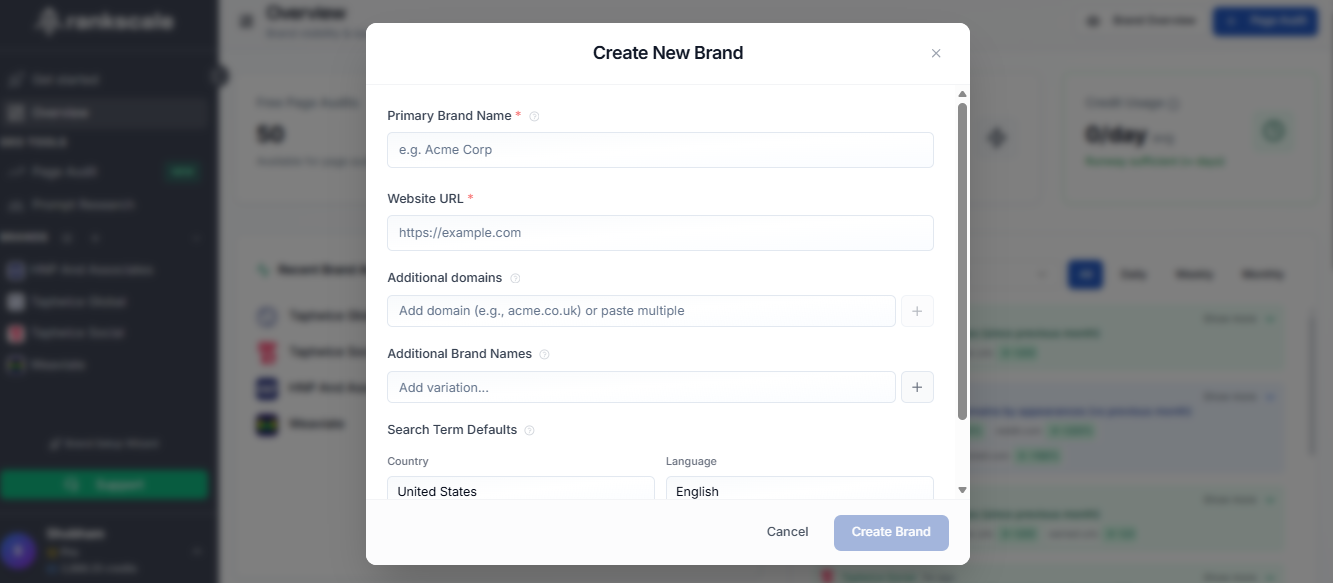
After signing up, click to create a new brand. The form asks for:
- Primary Brand Name — your main brand name as it should appear in AI answers
- Website URL — your primary domain
- Additional domains — any other domains associated with the brand
- Additional Brand Names — variations or alternate names AI engines might use when referring to you
- Search Term Defaults — default country and language for queries, which you can override per search term later
Step 2: Add Your Search Terms
Inside your brand, open the Add Search Terms screen. Each row represents one tracked query with the following columns: Search Term, Topic, Tags, Region, Language, AI Engines, Schedule, and Limit.
You have three ways to add terms:
- Add Row — add terms one at a time directly in the interface
- Paste Terms — paste a list of queries in bulk
- Upload CSV — upload a CSV with three fields: Topic, SearchTerm, and Tags. Region, language, engines, and schedule can be set after import.
For the AI Engines column, options include ChatGPT GUI, Gemini GUI, Perplexity GUI, AI Overview GUI, AI Mode GUI, Grok GUI, Copilot GUI, GPT-5, P Sonar, P Sonar-Pro, Gemini 3.0F, Claude 4.5H, DeepSeek V3, Mistral Large, and others. Each run costs 0.25 credits and the interface shows your projected daily usage before you confirm.
Step 3: Set Your Schedule
Each search term has its own schedule — Weekly or Every 2nd week. High-priority brand queries can run weekly while broader exploratory terms run less often to manage credit usage.
Step 4: Read Your Visibility Report
The visibility report shows where your brand appears in AI-generated answers for each tracked keyword — which engines mention you, how often, and whether your presence is growing or declining.
Step 5: Check Competitor Ranking in AI Answers
Rankscale shows how competitors rank in the same AI answers for the same queries. If a competitor consistently appears above you for a set of keywords, that is a direct signal to strengthen your content or authority in those topic areas.
Step 6: Manage Your Competitor List with Allowlist and Denylist
Rankscale automatically discovers brands appearing alongside yours in AI answers. If a brand shows up in your competitor reports but you do not want it counted there — a partner, a related entity, or a brand in a different segment — you can move it to the Denylist and it will be excluded from all competitor reports going forward.
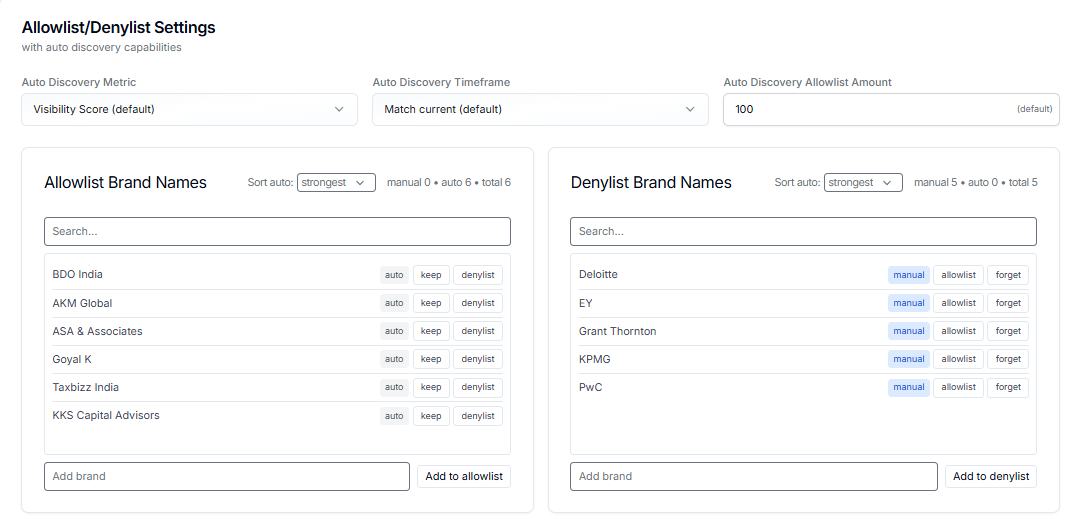
The Allowlist keeps brands you want tracked as competitors. The auto-discovery engine uses Visibility Score by default to surface the most relevant competitors, and you can control the timeframe and how many it pulls in automatically.
Step 7: Review Positive and Negative Sentiment
Every brand mention in an AI answer carries a tone. Rankscale categorizes mentions as positive, neutral, or negative. Negative sentiment appearing in AI answers is a reputational issue that requires a content or PR response before it compounds.
Step 8: Get Suggestions from Rankscale Scout
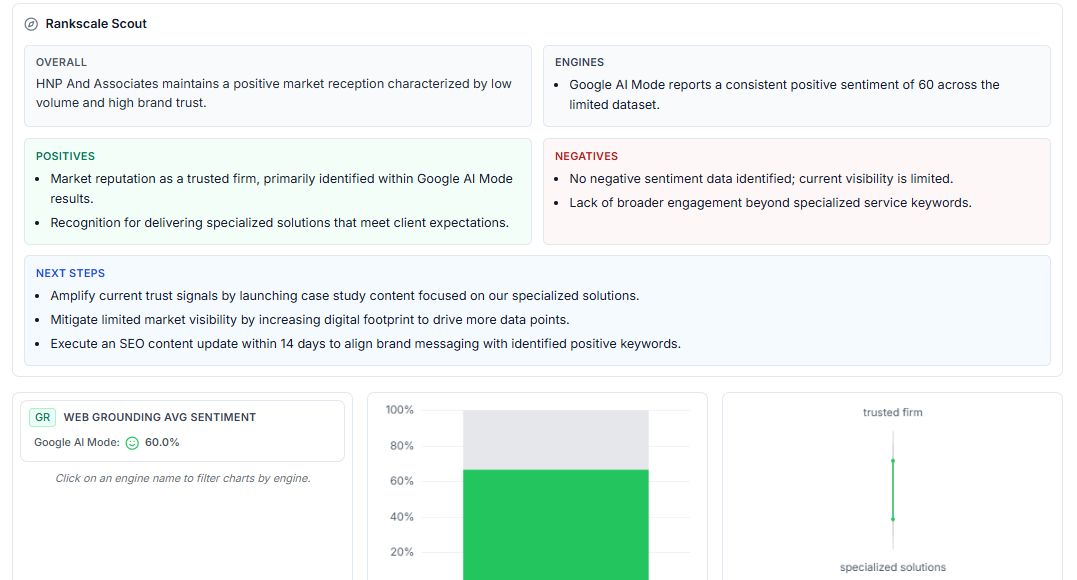
Rankscale Scout generates recommendations based on what the data shows. The report covers Overall market reception, Positives, Negatives, Engine-specific findings, and Next Steps — specific actions such as launching case study content, increasing digital footprint, or executing a content update within a target timeframe.
Step 9: See Which Websites Are Cited Most in Your Sector
The citations report shows which websites AI engines pull from most often when answering queries in your industry. It has several views:
- Top 20 Citations by Domain — a bar chart of the most frequently cited domains, filterable by engine
- Weekly Mentions by Top Domain — how citation frequency for each domain has changed week over week
- Citation Category Distribution — breaks down citations by content type such as blog, comparison, and directory
- Top Domains list — sortable by appearances, brands, first seen, and last seen, with share percentage per domain
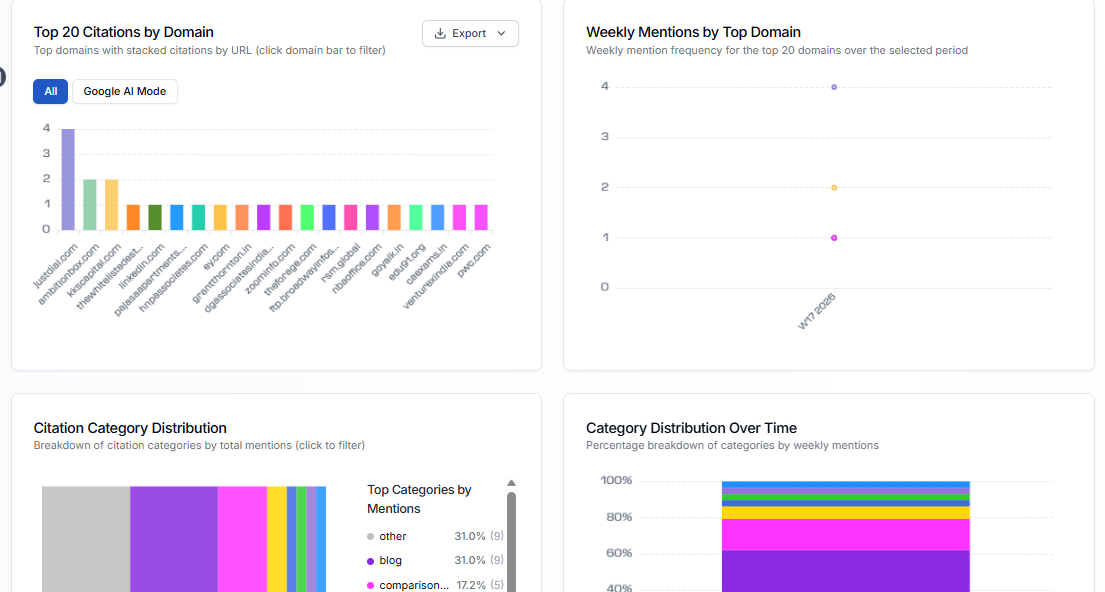
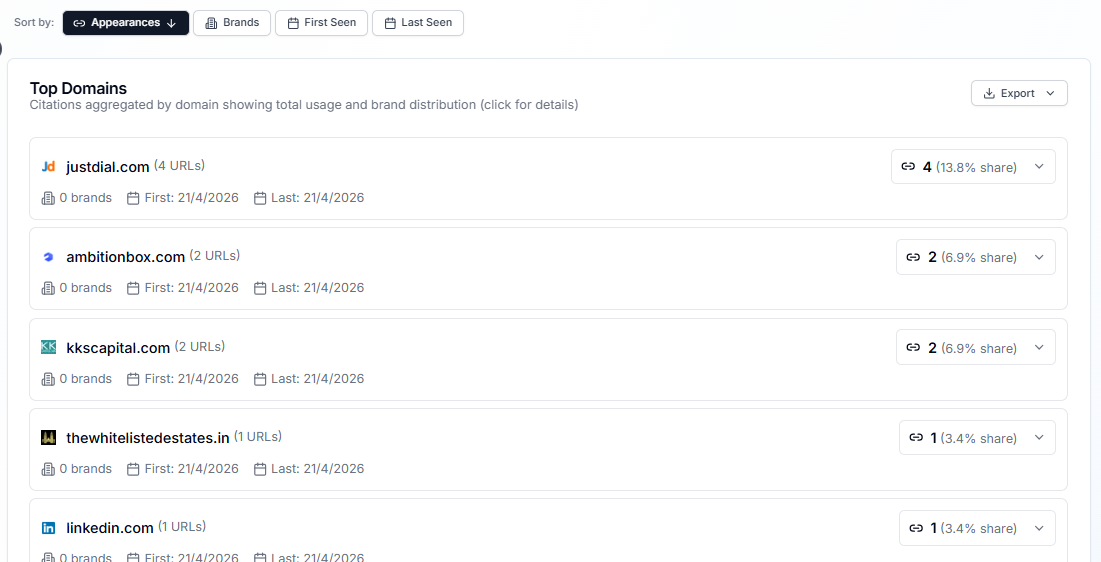
If a domain holds 13.8% of citations in your sector and you are not listed there, that is a direct gap to close. Getting covered on the highest-cited domains raises the probability that AI engines pull your brand into the answer for the next related query.
The Bottom Line
Automatic tracking of brand citations across AI engines is available now and the tools to do it properly have matured significantly over the past year. Rankscale is the strongest dedicated option for brands and agencies that need bulk tracking, scheduled automation, competitor management, and structured reporting across all major AI engines.
Want an expert to audit your Rankscale data and build your AEO plan?
Taptwice Media audits your AI visibility data, identifies the gaps your competitors are exploiting, and builds a structured AEO plan to get your brand cited in AI answers consistently.